
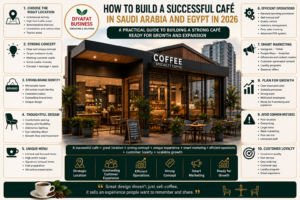
How to Create a Successful Cafe in Saudi Arabia and Egypt 2026: A Practical Guide to Building a Strong, Scalable, and Expandable Cafe
Restaurant & Cafe Encyclopedia — Deyafa Business
Consultants for Restaurant & Cafe Establishment and Development
Specialized Content in Operating, Developing, and Managing Food Projects & Building More Efficient and Stable Operating Systems
1️⃣ Why Are Cafes Among the Strongest Investment Projects?
💡 Sector Statistic:
The cafe sector in Saudi Arabia and Egypt is growing at a rate of 12-15% annually. The cafe is no longer just a place to sell coffee, but has become part of lifestyle, work environment, social gatherings, and content creation on social media.
Creating a successful cafe in 2026 depends not only on decor or coffee quality, but on:
Specific personality and identity
Understanding customers and competition
Speed and consistency
Comfort and return
Reach and spread
The strongest projects today are not necessarily the most expensive, but the most organized and capable of delivering a consistent and repeatable experience.
⚠️ The Truth:
Some investors enter the cafe sector because they love coffee or the atmosphere, but: love for the field alone is not enough to build a profitable and stable project.
—
2️⃣ Steps to Create a Successful Cafe – 10 Stages
The Ten Steps to Building a Successful Cafe:
2Define ConceptBuild clear identity8Hiring and TrainingImprove service
| # | Stage | Goal |
|---|---|---|
| 1 | Market Study | Understand competition and customers |
| 3 | Feasibility Study | Analyze investment and profitability |
| 4 | Choose Location | Reach the right customers |
| 5 | Design and Operations | Improve experience and efficiency |
| 6 | Choose Equipment | Ensure quality and stability |
| 7 | Build Menu | Increase profitability and reduce waste |
| 9 | Marketing | Attract customers |
| 10 | Soft Opening + KPIs | Test operations and improve performance |
—
🤔 The Starting Question…
If you were opening a cafe tomorrow, and you were asked to describe only two words that describe the experience of the cafe you dream of, what would you say?
These two words are your Concept.
If you can’t describe your cafe experience in two words, you haven’t defined its identity yet.
Examples:
• “Coffee + Speed” ← Grab & Go
• “Seating + Work” ← Community Cafe
• “Photography + Desserts” ← Dessert Cafe
• “Luxury + Privacy” ← Luxury Cafe
The two words determine: design, menu, prices, marketing, and even customer type.
3️⃣ Market Study, Concept, and Financial Study
📊 Stage One – Market Study and Competitor Analysis
💡 What some don’t notice: Some investors choose a crowded location, but they don’t study: are the existing customers actually the right customers for the cafe?—🎯 Stage Two – Choosing a Clear Concept
Successful cafes have a clear personality.
The Concept affects: design, menu, prices, marketing, and even customer type.
💰 Stage Three – Financial Feasibility StudyEBITDA Margin15% – 25%Below 10%
🧮 Prime Cost = Food Cost + Labor Cost
One of the most important indicators that determines: profit stability, operational strength, and management efficiency.
In many projects: High sales do not always mean high profits. Some cafes achieve good sales but suffer from: high labor costs, poor inventory control, or poor operations management.
4️⃣ Location, Design, Equipment, and Menu📍 Stage Four – Choosing the Location💡 Is the most expensive location the best? Not always. Some successful cafes operate in average locations with small spaces, but they have: strong operations, distinctive experience, and clear identity.—🎨 Stage Five – Cafe Design
Today, design has become part of: marketing, customer experience, and brand spread on social media.
What should the design achieve?
- 😊 Customer comfort
- 🏃 Ease of movement
- ⚙️ Workflow improvement
- 📸 Photographability
- ⏱️ Improving customer dwell time
🧠 Psychology of Space: Table distribution, lighting, music, and colors psychologically affect: customer comfort, dwell time, and order volume.—⚙️ Stage Six – Choosing Equipment
Equipment is not just buying machines, but an investment that affects operations and profitability.
BreakdownsLoss reductionWorkflowPressure reduction
| Element | Why It Matters? | 🛠️ How to Study It? |
|---|---|---|
| Number of competitors | Measure market strength | Google Maps + field visits |
| Average prices | Determine positioning | Browse competitor menus |
| Target audience | Build appropriate experience | Observe customers |
| Peak hours | Organize operations | Visit at different times |
| Google Reviews | Understand market problems | Read ratings |
| Most requested products | Improve menu | Monitor orders |
| Idea | Type | 👥 Target Customer |
| Specialty coffee and professional experience | Specialty Coffee | Coffee enthusiasts |
| Speed and fast service | Grab & Go | Employees and busy people |
| Luxury experience | Luxury Cafe | Upscale clientele |
| Seating, work, and meetings | Community Cafe | Students and freelancers |
| Desserts and photography experience | Dessert Cafe | Youth and social media |
| Indicator | Healthy Range | ⚠️ Danger Zone |
| Food Cost | 28% – 35% | +40% |
| Labor Cost | 20% – 25% | +30% |
| Prime Cost | Below 60% | +65% |
| Rent Ratio | Below 12% | +18% |
| Waste Percentage | Below 2% | +5% |
| Element | Impact | |
| Ease of access | Increased visits | |
| Parking | Customer comfort | |
| Area characteristics | Determine target audience | |
| Competition | Measure opportunities | |
| Population density | Demand volume | |
| Element | Impact | |
| Preparation speed | Service improvement | |
| Quality | Product consistency | |
| Electricity consumption | Cost control |
—
📋 Stage Seven – Preparing a Professional Menu
A successful menu does not depend on many options, but on: product clarity, profitability, ease of operation, and waste reduction.
🧠 Menu Engineering: Some products achieve high sales but have low profit margins. Other products are more profitable but not highlighted.
How does the menu increase profits? Improving product arrangement, highlighting higher-profit items, reducing weak products, and using upselling.
5️⃣ Hiring, Training, and Marketing
👥 Stage Eight – Hiring and Training
Employees represent the brand’s image in front of customers. Service quality, execution speed, and customer handling — all depend on training and operational consistency.
SOPs – Standard Operating Procedures help with: quality standardization, error reduction, easier training, and improved scalability.
| Element | Organized Cafe ✅ | Random Cafe ❌ |
|---|---|---|
| Quality | Consistent | Varying |
| Operations | Stable | Chaotic |
| Profits | Clearer | Fluctuating |
| Training | Organized | Weak |
| Scalability | Easier | Difficult |
—
📣 Stage Nine – Marketing for Cafes
Google MapsLocal visibilityUGC ContentTrust building
| Channel | Impact |
|---|---|
| TikTok | Rapid spread |
| Brand building | |
| Influencers | Customer reach |
—
🧪 Stage Ten – Soft Opening + Key KPIs
A soft opening helps with: testing operations, training the team, discovering problems, and improving quality before the official opening.
Many problems only appear during real operations.
| KPI | Why It Matters? |
|---|---|
| Average Ticket | Average spending |
| Repeat Rate | Customer loyalty |
| Ticket Time | Service speed |
| Google Rating | Reputation |
| Food Cost | Profitability |
| Waste Percentage | Waste reduction |
6️⃣ Smart Cafes 2026 + Two Case Studies
🤖 Smart Cafes
Modern cafes have started relying on:
🔮 AI Forecasting
📦 Smart Inventory
📊 Automated Dashboards
👥 Customer Analytics
Artificial intelligence helps with: predicting peak times, customer analysis, waste reduction, and operations improvement.
—
☕ Case Study – A Specialty Cafe in Riyadh
The Problem: Started with strong design, but faced slow operations, high Food Cost, and weak return rate.
The Solution: Redesigning workflow, developing SOPs, improving the menu, training the team, and improving Google Reviews.
| Indicator | Before | After 5 Months |
|---|---|---|
| Food Cost | 38% | 30% |
| Ticket Time | 12 minutes | 6 minutes |
| Google Rating | 4.1 | 4.7 |
| Repeat Rate | Low | Clear improvement |
☕ Case Study – A Cafe in New Cairo
The Problem: Good location and strong design, but unclear identity, weak marketing, and unstable sales.
The Solution: Developing visual identity, improving content, building a Loyalty Program, and improving the seating experience.
Google ReviewsAverageNotable improvement
| Indicator | Before | After 6 Months |
|---|---|---|
| Average Ticket | Low | +18% |
| Repeat Rate | Average | +39% |
| Instagram Engagement | Weak | Strong growth |
—
⚠️ Real Operational Pressure
Running a cafe is not just about making coffee. It includes: employee management, customer pressure, cost control, and dealing with daily competition.
Some investors consume most of their budget on design and furniture, only to discover later that they do not have sufficient operational liquidity or a clear plan for the first 6 months.
—
💀 Common Mistakes That Destroy Some Cafes
7️⃣ Conclusion
🎯 The Formula for a Successful Cafe in 2026
🎨 Identity
📣 Marketing
📋 Systems
💰 Financial Control
Creating a successful cafe no longer depends only on decor or coffee quality. The cafes that truly succeed are those that can: build a stable experience, deliver consistent quality, and achieve a balance between operations, profitability, and growth.
—
🚀 The Future of Cafes in 2026
The strongest projects will be:
Data-Driven + Experience-Focused + AI-Assisted + Community-Based
Projects that rely on: data, operations, customer experience, and content.
8️⃣ Frequently Asked Questions
Q1: What is the most important step in creating a successful cafe?
Q2: Is a market study necessary?
Q3: Is decor more important than operations?
Q4: What is the importance of visual identity?
Q5: How do I choose the right location?
Q6: Can small cafes succeed?
Q7: What is the importance of SOPs for cafes?
Q8: How can I increase cafe profits?
Q9: What is the most important KPI to track?
Q10: Is marketing alone enough?
—
📣 Do You Need to Develop or Establish a Cafe More Professionally?
Cafe success depends not only on ideas or design, but on building stable operations, a strong customer experience, and a system that helps achieve sustainable and scalable profits.
Prepared by: The Development & Operations Team, Deyafa Business
📞 Contact the Development & Operations Team
Deyafa Business provides comprehensive services: feasibility studies, concept and operational identity development, operating system design, and preparing cafes for opening and expansion.
Did this guide help you?
Your opinion matters to us — it helps us develop better content that suits your needs
Our clients’ trust is our success
