
Fast Food Restaurants 2026: How to Achieve the Highest Profits from a Successful Fast Food Project in Saudi Arabia and Egypt?
Restaurant & Cafe Encyclopedia — Deyafa Business
Consultants for Restaurant & Cafe Establishment and Development
Specialized Content in Operating, Developing, and Managing Food Projects & Building More Efficient and Stable Operating Systems
- Why Are Fast Food Restaurants Among the Most Profitable Projects?
- Why Do Some Fast Food Restaurants Fail Despite Crowds?
- Key Operational and Financial Indicators
- Speed – The Secret Weapon of Profitability
- Drive Thru and Delivery Apps
- Kitchen Management and Waste Reduction
- Case Study – A Burger Restaurant in Riyadh
- Technology and the Future of Fast Food 2026
- Conclusion
- Frequently Asked Questions
1️⃣ Why Are Fast Food Restaurants Among the Most Profitable Projects?
💡 Did you know?
Fast food restaurants achieve the highest inventory turnover rate among all types of restaurants. On average, every riyal invested in inventory turns over 3-4 times per month, creating fast and strong cash flow.
Increasing fast food restaurant profits does not depend only on the number of orders or crowds, but on:
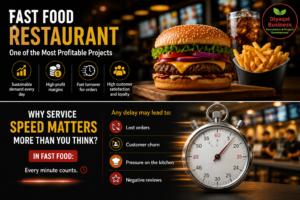
Every minute = money
Fewer losses
Return and loyalty
Better margins
Real profit after commission
The strongest projects in 2026 are those that can achieve a balance between speed, quality, and profitability at the same time.
📊 Why Is Fast Food Different?
High daily transaction volume
Wide and repeat customer base
Replicable model
Revenue from morning until late night
⚠️ The Common Misconception
Some investors believe that fast food success depends only on:
- 🍔 Taste
- 📍 Or location
While the truth is that:
Operational speed and discipline may be more important than the product itself at times.
🤔 Think with me…
Burger Restaurant: Your order is ready in 4 minutes, hot, with no errors.
Burger Restaurant: Your order is ready in 11 minutes, warm, with a small error.
Which restaurant will you return to next week?
78% of customers prefer speed and consistency over “slightly better” taste.
In fast food, speed is part of the product itself. Not an add-on, but an essential component of the experience.
2️⃣ Why Do Some Fast Food Restaurants Fail Despite Crowds?
A dangerous phenomenon: the restaurant is crowded, but it doesn’t make money.
✅ What Everyone Sees:
- 👥 Queues and waiting
- 📋 Many orders
- 🛵 Presence on delivery apps
- 📱 Strong social media presence
❌ What It Suffers Internally:
- 📈 Weak net profits
- 👥 High labor cost
- 🍔 High Food Cost
- 🗑️ High waste
- 🔍 Weak operational oversight
- 🏷️ Discounts eroding margins
Some fast food restaurants achieve high sales, but their profit margin is weak due to: continuous discounts, app commissions, slow operations, or poor kitchen management.
3️⃣ Key Operational and Financial Indicators for Fast Food Restaurants
| Indicator | Healthy Range | ⚠️ Danger Zone | 🛠️ Measurement Tool |
|---|---|---|---|
| Food Cost | 32% – 38% | +42% | Food cost report |
| Labor Cost | 20% – 25% | +30% | Payroll report |
| Prime Cost | Below 60% | +65% | Dashboard |
| EBITDA Margin | 15% – 22% | Below 10% | Income statement |
| Drive Thru Time | Under 4 minutes | +6 minutes | Electronic timer |
| Ticket Time | Under 6 minutes | +9 minutes | KDS |
| Food Waste | Below 3% | +6% | Waste log |
| Google Rating | 4.5+ | Below 4.0 | Google Business |
| Repeat Customers | High | Declining | Loyalty program/POS |
📋 Scorecard – Your Restaurant’s Performance Evaluation
Check ✅ what applies:
- ☐ Food Cost below 38%
- ☐ Labor Cost below 25%
- ☐ Prime Cost below 60%
- ☐ Ticket Time under 6 minutes
- ☐ Drive Thru under 4 minutes
- ☐ Waste below 3%
- ☐ Google Rating 4.5+
- ☐ I have written SOPs for peak hours
6-8 checks = Strong performance | 4-5 = Needs a plan | Below 4 = Dangerous situation
4️⃣ Speed – The Secret Weapon of Profitability
⏱️ In Fast Food: Every Minute = Money
Any delay can lead to:
- 🚫 Lost orders
- 🪑 Lower customer turnover
- 🔥 Kitchen pressure
- ⭐ Negative ratings
🧠 Customer Fact:
The customer at fast food restaurants is not only looking for food, but for:
- ⚡ Speed
- 👍 Ease
- ⏳ Minimized waiting time
Even a small delay can affect their decision to return again. Speed is not an add-on, it is part of the product.
⚡ Why Is Service Speed an Important Financial Element?
The faster you are, the more customers you serve at the same time
Customer leaves = new customer sits
Speed is one of the most mentioned things in customer reviews
Especially during limited peak hours
🎯 Exercise: Calculate Your Loss from Slowness
If your current order preparation time = 10 minutes, and your peak hour order volume = 60 orders/hour.
If you could reduce the time to 6 minutes, the possible number of orders becomes = 100 orders/hour.
That means 40 additional orders × average ticket = thousands of riyals monthly!
5️⃣ Drive Thru and Delivery Apps – Opportunity or Trap?
🚗 The Importance of Drive Thru in Increasing Profits
Drive Thru service has become one of the most important sales sources in:
- 🍔 Burgers
- ☕ Coffee
- 🍗 Fried chicken
- 🥤 Fast beverages
How does Drive Thru help improve profitability?
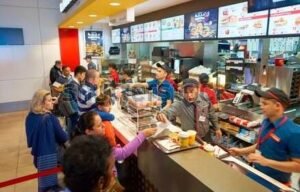
🧠 Drive Thru Psychology: The customer at Drive Thru wants:
- 📋 Fast ordering
- 👍 Easy experience
- 🚫 Minimal friction
- ✅ Accurate execution without delay
Fact: Some customers choose a particular restaurant only because the Drive Thru is faster and easier than competitors.
🛵 Do Delivery Apps Increase Your Profits or Eat Them Away?
Delivery apps have become a major source of sales, especially in Saudi Arabia and Egypt.
But they can pressure profit margins due to: commissions, discounts, packaging, and delivery fees.
Element Impact🔧 How to Handle It?
| App commissions | Reduced profit margin | Calculate profitability after commission |
| Poor packaging | Returns and complaints | Invest in thermal packaging |
| Delay | Negative ratings | Monitor preparation time |
| Many discounts | Profit erosion | Set a discount ceiling |
| Poor order management | Operational pressure | Separate order management system |
📦 Packaging – Not Just a Box
Packaging is no longer just a means to carry the product. It has become part of:
- ⭐ Customer experience
- 🍔 Product quality
- 📸 Brand image
Good packaging helps with:
- 🔥 Maintaining food temperature
- 🔄 Reducing returns
- 🛵 Improving delivery experience
- ⭐ Improving customer ratings
6️⃣ Kitchen Management and Waste Reduction – The Real Profit Battle
🗑️ Daily Profit Leakage
One of the most dangerous fast food problems is daily profit leakage.
🗑️ Waste
⚖️ Excess quantities
🧾 Cashier errors
🐌 Delay
🦠 Spoiled products
👥 Unproductive labor
Some projects lose thousands of riyals monthly due to recurring small errors, weak follow-up, and lack of daily operational oversight.
🔥 Operational Problems During Peak Hours
The most common fast food problems during peak hours:
- 😰 Cashier crowding
- 🔥 Kitchen pressure
- ⏰ Order delays
- ❌ Increased errors
- 📉 Quality decline under pressure
Restaurants that operate without clear SOPs, organized workflow, or good task distribution turn peak hours into pressure, chaos, and operational losses.
📋 SOPs – Why Are They the Best Investment in Your Restaurant?
The same taste every time
New employee = ready faster
No random efforts
Clear steps = less time
📊 Comparison: Organized Operations vs. Random Operations
| Organized Operations ✅ | Random Operations ❌ |
|---|---|
| Consistent experience | Quality variation |
| Clear workflow | High pressure |
| Better oversight | Frequent errors |
| Higher speed | Slow service |
| Better financial control | High waste |
🧮 Prime Cost & EBITDA
🧮 Prime Cost = Food Cost + Labor Cost
Healthy range: Below 60%
If it exceeds 65% → Danger indicator for profitability, cash flow, and project stability
📊 EBITDA
Helps measure: operational strength | real performance | profitability before accounting expenses
7️⃣ Case Study – A Fast Food Burger Restaurant in Riyadh
🍔 Situation Before Development
The restaurant was:
- ✅ Achieving good sales
- ✅ Had a strong location in North Riyadh
- ✅ Experiencing high pressure during evenings and weekends
But management noticed:
- 📉 Declining profits despite crowds
- 🐌 Slow Drive Thru
- ⭐ Declining Google ratings
- 📝 Increase in complaints related to delays and order quality
🔴 The Real Problems Discovered
The problem was not burger quality or lack of demand, but operations’ inability to handle daily order volume in a fast and competitive market like Riyadh.
📊 Indicators Before Development
Indicator Before Development⚠️ Assessment Prime Cost70%🚨 Danger
| Food Cost | 37% | Within healthy range |
| Labor Cost | 33% | 🚨 Very high |
| Ticket Time | 10 minutes | 🚨 Slow |
| Drive Thru Time | 8 minutes | 🚨 Very slow |
| Google Rating | 4.1 | ⚠️ Needs improvement |
| Waste Percentage | 6% | 🚨 High waste |
| Repeat Customers | Low | 🚨 Loyalty problem |
🟢 Development Plan (5 Steps)
Reduce random movement, reorganize workstations, improve order flow
Improve order reception, reduce payment time, allocate staff for peak hours
Burger preparation, order management, delivery, cleaning, handling pressure
Organize orders, improve packaging, reduce delays
Ticket Time, Drive Thru, Food Cost, Waste, Google Reviews
📊 Results After 6 Months
Prime Cost70%53%⬇️ 17 points ✅
| Indicator | Before | After | 📈 Improvement |
|---|---|---|---|
| Food Cost | 37% | 32% | ⬇️ 5 points |
| Labor Cost | 33% | 24% | ⬇️ 9 points |
| Ticket Time | 10 minutes | 5 minutes | ⬇️ 50% |
| Drive Thru Time | 8 minutes | 3.5 minutes | ⬇️ 56% |
| Google Rating | 4.1 | 4.6 | ⬆️ 0.5 stars |
| Waste Percentage | 6% | 2.7% | ⬇️ 55% |
| Repeat Customers | Low | Clearly increased | ⬆️ Noticeable |
🎯 Lessons Learned from This Study
- The project didn’t need to completely change the product, it needed more organized operations
- Reducing Prime Cost from 70% to 53% is what actually saved the profits
- Speed and consistency were the keys to improving Google ratings and customer return
- The Riyadh market is fast, customers compare execution speed, not just food quality
8️⃣ Technology and the Future of Fast Food 2026
🚀 Fastest Growing Activities
🤖 AI & Smart Kitchens
Smart Inventory Smart counting and forecasting Fewer inventory discrepancies
| Technology | Benefit | ⚡ Impact |
|---|---|---|
| AI Forecasting | Demand prediction | Less waste |
| Smart Kitchens | Workflow improvement | Higher speed |
| AI Drive Thru | Faster ordering | Less wait time |
| Predictive Staffing | Smart labor distribution | Lower labor cost |
| Automated Kitchen | Accurate execution | Fewer errors |
🧠 Predictive Staffing – A Revolution in Labor Management
Some modern systems can:
- ⏰ Predict peak times
- 👥 Automatically distribute labor
- 📉 Reduce crowding
Based on: past data, seasons, and expected demand.
Projects that rely solely on “personal experience” are slower to develop compared to projects that rely on data, technology, and operational analysis.
9️⃣ Conclusion
🎯 The Success Formula for Fast Food 2026
💰 Cost control
⭐ Customer experience
🛵 Delivery management
🗑️ Waste reduction
📊 Data analysis
The strongest projects in 2026 will be: the fastest, most organized, and best at turning good operations into stable profits and sustainable growth.
📊 Quick Executive Roadmap
4Analyze profitability of each delivery channelNext month6Invest in Smart Kitchen Within 90 days
| Step | Action | ⏱️ When? |
|---|---|---|
| 1 | Measure Ticket Time and Drive Thru Time | Today |
| 2 | Calculate your actual Prime Cost | This week |
| 3 | Build SOPs for peak times | This week |
| 5 | Set up a daily KPI dashboard | Within 30 days |
🔟 Frequently Asked Questions
Q1: Are fast food restaurants really profitable?
Q2: Do delivery apps reduce profits?
Q3: What is the importance of service speed?
Q4: What is the healthy range for Food Cost in fast food?
Q5: Why are SOPs important?
Q6: How do Google Reviews affect sales?
Q7: Does Drive Thru increase profits?
Q8: What is the biggest cause of declining profits in fast food restaurants?
📣 Deyafa Business Services for Establishing, Developing, and Operating Restaurants and Cafes
Some challenges inside restaurants and cafes are not only related to sales, but may be related to:
Weak operations |
High costs |
Waste |
Unclear systems |
Declining customer experience
Prepared by: The Development & Operations Team, Deyafa Business
🆕 New Project Services
- 📊 Feasibility study and financial analysis
- 🎯 Concept and operational identity development
- 📋 Operating systems and procedures design
- 🏗️ Kitchen and cafe planning and setup
- 📝 Menu development and pricing
- 🎓 Training and preparation before opening
- 📈 Operational and growth plan preparation
🔄 Existing Project Services
- 🔍 Operational problem analysis and diagnosis
- 💰 Profitability improvement and waste reduction
- ⭐ Operational and service quality development
- 🏗️ Operational and management restructuring
- 😊 Customer experience improvement
- 📊 Financial and operational performance development
- 📈 KPI and monitoring system development
- 🚀 Preparing projects for expansion or franchising
Deyafa Business provides consulting and operational solutions based on analysis, practical experience, and understanding of market nature.
Did this guide help you?
Your opinion matters to us — it helps us develop better content that suits your needs
Our clients’ trust is our success
