1 How to Develop Restaurants and Cafes and Increase Profits 2026: Modern Operational and Marketing Strategies to Build a Stronger and More Profitable Project
Restaurant & Cafe Encyclopedia — Deyafa Business Consultants for Restaurant & Cafe Establishment and Development Specialized Content in Operating, Developing, and Managing Food Projects & Building More Efficient and Stable Operating Systems
1️⃣ Why Do Restaurants Need Continuous Development?
💡 Market Fact:
The restaurant market is changing rapidly. 78% of customers in Saudi Arabia and Egypt have tried a new restaurant in the last 3 months based on what they saw on TikTok, Instagram, or Google Reviews. Restaurants that do not evolve lose their customers silently — not because of food quality.
Developing restaurants and cafes in 2026 is no longer just changing decor or adding a new item, but has become a continuous process linked to:
🧠 Understanding the market and customer behavior
⚙️ Operations speed and efficiency
🎨 Identity clear personality
🤖 Technology data and decisions
⭐ Customer experience the complete journey
profit increase
Many projects start strong, then sales gradually decline despite product quality. The reason is often not the food itself, but the failure to develop operations and keep up with market and customer changes.
⚠️ Realistic View:
The problem is not always in the food. Some restaurant owners believe that declining sales mean weak products, but the real problem may be in:
🐌 Slow service
📦 Poor packaging
🪑 Weak atmosphere
🗣️ Staff handling manner
📉 The experience not evolving compared to competitors
Today’s customer evaluates: the complete experience — not just the food.
🤔 The Development Question…
If you asked 10 of your previous customers who didn’t return: “Why didn’t you come back?” — what do you expect they would say?
The most common answers from lost customers:
1. “Service is slow” — 34% 2. “There’s a faster place nearby” — 22% 3. “Quality varies each time” — 18% 4. “Nothing new” — 14% 5. “Prices aren’t worth it” — 12%
Notice that 74% of the reasons have nothing to do with food quality itself! The real opportunity for development is often in operations and experience, not in the product.
📉 Why Do Some Restaurants Decline After a Strong Opening?
🚀 Strong Start:
👤 Influencers
📸 Professional photography
📣 Marketing campaigns
👀 Curiosity
📉 Decline:
⭐ Negative ratings
📉 Quality decline
⏰ Delays
🚫 Gradual customer loss
The reason: operations are not ready to maintain quality under pressure.
🚨 Busy But Weak — Unprofitable Crowding
Some restaurants appear very successful due to: crowds, queues, high order volume.
But internally they suffer from: weak profits, high costs, waste, weak operations, or lack of oversight.
Some project owners link crowds to financial success, while real profitability depends on: operational quality, cost control, service speed, and daily management efficiency.
2️⃣ Signs That Your Restaurant Needs Actual Development
High wasteLow profitsWeekly inventory
Sign
Impact
🔧 Immediate Action
Declining ratings
Decreased visits
Review Google Reviews weekly
Slow service
Customer loss
Measure Ticket Time
Many complaints
Weak loyalty
Daily complaint log
Weak social media engagement
Declining reach
Content development
Low return rate
Weak customer experience
Measure Repeat Rate
⭐ How Does Customer Experience Affect Profits?
Customers who have a good experience are more likely to:
🔄 Return
🛵 Order again
🗣️ Recommend the place
📝 Write positive reviews
Even a small difference in: service speed, cleanliness, handling manner, or seating comfort can directly affect ratings, sales, and return rates.
💡 Real example: Some customers don’t remember food details as much as they remember: ease of experience, order speed, comfort, or how they felt inside the place.
3️⃣ Developing Operations, Menu, and Technology
⚙️ Operations Development Is More Important Than Rapid Expansion
Some investors think about opening a new branch before solving operational problems in the first branch.
Successful projects: develop systems and quality first, then begin gradual and deliberate expansion.
💀 Emotional Expansion
Some projects open new branches due to: enthusiasm, temporary crowds, competitive pressure.
Without ensuring: operational readiness, quality consistency, management strength, or team readiness.
The result: the same problems transfer to new branches — larger and more costly.
💡 Real example: Some projects make major decisions based on “feeling” or personal impressions, while data sometimes reveals completely different problems than expected.
📋 Smart Menu Development — Menu Engineering
A strong menu does not depend on the number of items, but on: balance between profitability and demand, ease of operation, reduced complexity, preparation speed, and improved customer experience.
Weak profitability Higher profit margin
Random Menu ❌
Smart Menu ✅
Many items
Studied items
Complex operations
Faster operations
High waste
Better control
👥 Employee Training — Investment, Not Cost
Trained employees: reduce errors, improve operational speed, raise service quality, and help improve ratings.
😰 Staff Fatigue
Employees in a disorganized operational environment: consume more energy, face pressure, make more errors, and their productivity decreases over time.
A strong team depends not only on skill, but on: system clarity, ease of operation, task distribution, and clear SOPs.
🔥 Operational Pressure
Projects that operate without clear systems, SOPs, and organized workflow are more prone to chaos during peak hours.
The result: delays, complaints, waste, and continuous daily pressure.
4️⃣ Identity, Design, and Speed
🎨 Identity Development — Why Are Some Brands Easier to Remember?
A strong identity makes the project: easier to remember, more shareable, stronger on social media, and clearer to customers.
💡 Real example: Some cafes succeed because customers feel the place has a clear personality, different experience, and consistent identity — not just because of product quality.
📸 How Do Photos and Professional Photography Affect Sales?
Today’s customers see photos before tasting the food. Poor photos, bad lighting, or unprofessional photography may reduce sales even if products are excellent.
Some customers decide to order within seconds based solely on visual impression, especially on delivery apps and social media.
Today’s customers expect faster service, especially with delivery apps, quick orders, and Grab & Go.
🎯 Healthy Ticket Time: Under 7 minutes
Even a small delay may drive customers to try a competitor.
🏷️ Smart Offers Instead of Random Discounts
Some restaurants rely on continuous discounts, which: reduces profit margins, weakens brand value, and makes customers always wait for discounts.
Smart offers help: increase average ticket, increase visit frequency, and improve customer experience — without harming profitability.
5️⃣ Resistance to Change and Investor Anxiety
🛑 Resistance To Change
Some projects recognize clear problems but hesitate to develop due to fear of: losing customers, changing the usual system, development costs, or failure.
The problem: delaying development often makes problems bigger and more costly in the future.
😰 Investor Anxiety
Some investors fear development or hesitate to update operations despite clear daily problems.
The real problem sometimes is not the cost of development, but the cost of continuing with the same mistakes.
💰 How Does Weak Operations Affect Profits?
Every operational error costs the project money even if it doesn’t appear immediately.
Examples: reworking orders, waste, complaints, returns, negative ratings — all affect: profits, reputation, and return rates.
🤝 How Do You Build Customer Loyalty?
Customers return to a place that gives them: a stable experience, fast service, consistent quality, and comfort in dealing.
Some projects have excellent products but fail to build a strong customer base due to: quality variation, poor communication, or unstable experience.
🔄 Development Doesn’t Mean Changing Everything
Some projects engage in random development that confuses customers and increases costs without clear results.
Smart development means: gradually improving weaknesses, maintaining identity, developing operations, and improving experience without losing brand personality.
📋 The Importance of SOPs in Restaurant Development
Organized Project ✅
Random Project ❌
Consistent experience
Quality variation
Clear SOPs
Weak training
Stable quality
Frequent complaints
Stronger oversight
High waste
Easier growth
Difficult expansion
6️⃣ 7 Practical Steps to Develop Restaurants and Cafes + Conclusion
1️⃣ Accurately Analyze Current Problems
Collect data, reviews, complaints — and understand where the problem really is.
2️⃣ Improve Operations and SOPs
Document procedures, standardize standards, train the team.
3️⃣ Develop the Menu Intelligently
Remove weak items, highlight strong ones, improve average ticket.
4️⃣ Improve Customer Experience
Speed, comfort, cleanliness, handling — all are one experience.
5️⃣ Develop Identity and Photography
Strong visual identity, professional photos, fresh content.
6️⃣ Track Data and KPIs
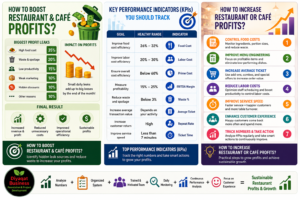
Food Cost, Repeat Rate, Ticket Time, Google Rating — weekly.
7️⃣ Gradual, Studied Development
Don’t change everything at once. Improve step by step.
🎯 Conclusion
The Sustainable Development Formula
⚙️ Operations ⭐ Customer experience 🤖 Technology 📊 Data analysis 🎓 Training 🎨 Identity ⚡ Adaptation speed
Developing restaurants and cafes in 2026 depends on these combined elements.
Projects that continuously develop and understand customer and market changes are more capable of: increasing profits, improving ratings, building customer loyalty, and expanding in a stable and sustainable manner.
📊 Checklist: Is It Time to Develop Your Restaurant?
☐ Google Rating below 4.3
☐ Ticket Time above 10 minutes
☐ Repeat Rate below 30%
☐ Food Cost above 38%
☐ Complaints are increasing
☐ Social media engagement is declining
☐ Menu hasn’t been updated in over a year
3 or more signs = your project needs an urgent development plan.
“Development is not a luxury, it is the cost of survival in a market that waits for no one.”
📣 Do You Need to Develop Your Restaurant or Cafe?
Some challenges are not only related to sales, but may be related to:
Weak operations | High costs | Waste | Unclear systems | Declining customer experience
Prepared by: The Development & Operations Team, Deyafa Business
📞 Contact the Development & Operations Team
Deyafa Business provides operational problem analysis and diagnosis services, profitability improvement, operational quality development, and preparing projects for expansion.
⭐ ⭐ ⭐ ⭐ ⭐
Did this guide help you?
Your opinion matters to us — it helps us develop better content that suits your needs