
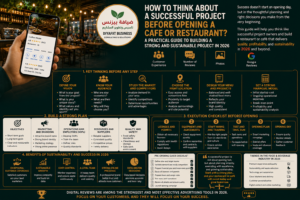
How Do Successful Projects Think Before Opening a Restaurant or Cafe? A Practical Guide to Building a Strong and Stable Project in 2026
Restaurant & Cafe Encyclopedia — Deyafa Business
Consultants for Restaurant & Cafe Establishment and Development
Specialized Content in Operating, Developing, and Managing Food Projects & Building More Efficient and Stable Operating Systems
- Success Begins with the Way of Thinking, Not Decor
- Why Do Some Restaurants Disappear After Opening?
- Does the Market Really Need Your Project?
- Small or Big? Emotional vs. Rational Expansion
- The Market After Delivery Apps and Digital Ratings
- Financial and Operational Indicators + Two Case Studies
- Conclusion
- Frequently Asked Questions
1️⃣ Success Begins with the Way of Thinking, Not Decor
💡 Starting Truth:
The success of restaurants and cafes does not begin with decor, marketing hype, or number of followers. Rather, it begins with: the way of thinking, planning strength, market understanding, and building stable operations capable of continuing and achieving profits.
Successful projects think first about:
How will the place work daily?
Are the numbers logical?
What will the customer feel?
What if things don’t go as planned?
Successful projects think about these elements before thinking about appearance or rapid spread.
⚠️ The Truth That Many Investors Don’t Talk About
A love of coffee or food does not necessarily mean the ability to manage a successful project.
The restaurant sector requires: daily decisions, pressure management, financial oversight, and quick solutions to operational problems.
—
📊 The Difference Between a Beautiful Project and a Sustainable Project
| Beautiful Project 🎨 | Sustainable Project ✅ |
|---|---|
| Strong design | Strong operations |
| Eye-catching opening | Stable quality |
| High spending | Financial oversight |
Rapid spreadStable profits
Marketing hypeProfessional management
—
🤔 The Starting Question…
If you had two options: a project with luxurious design and monthly costs of 90,000 SAR, or a simple project with costs of 40,000 SAR — both the same idea and same area. Which would you choose and why?
The smart investor chooses the lower-cost project at the beginning.
Why?
- 📉 Lower break-even point = faster profitability
- 🛡️ Larger safety margin if sales decline
- 🧪 Flexibility for trial and error without fatal financial pressure
- 🚀 After operations stabilize, expansion and upgrades are possible
Luxury can come later. Survival must come first.
2️⃣ Why Do Some Restaurants and Cafes Disappear After Opening?
Some projects achieve: a strong opening, rapid spread, and clear crowds.
But they begin to decline after a few months due to:
- ⚙️ Weak operations
- 💰 Poor financial planning
- 📈 High costs
- 👥 Team unpreparedness
—
🔴 Why Do Some Strong Openings Fail?
✅ Prepare for:
- 📸 Photography
- 📣 Marketing campaign
- 👤 Influencers
❌ Do NOT prepare for:
- 🔥 Operational pressure
- 📊 Order volume
- ✅ Quality management under pressure
The result: Order delays ← quality decline ← negative ratings ← rapid customer loss.
3️⃣ Does the Market Really Need Your Project?
One of the biggest mistakes: Building a project based solely on personal taste.
Some investors choose an idea because they:
- 🍔 Like a certain type of food
- 🏙️ Were impressed by a project in another city
- 📱 Saw a popular trend
Without studying: demand volume, customer nature, or actual competition.
📊 How to Study the Market Correctly?
| Element | Why It Matters? | 🛠️ How to Study It? |
|---|---|---|
| Number of competitors | Measure market strength | Google Maps + field visits |
| Target audience | Understand customers | Observe customers |
| Average prices | Determine your market position | Browse menus |
| Competitor ratings | Discover weaknesses | Google Reviews |
| Peak hours | Understand operational volume | Visit at different times |
| Strong areas | Choose appropriate location | Density analysis |
—
🔄 Why Shouldn’t You Imitate Successful Projects?
The success of some brands depends not only on the idea or design, but on: experience, management, timing, and operational strength.
What some don’t notice: Some projects imitate the menu, design, or visual identity, but they do not see the internal systems, management quality, or operational strength behind the scenes.
—
🧪 How to Test an Idea Before Investing the Full Budget?
Some smart projects start through:
Why? To understand the market, customers, and demand behavior — before committing to a long-term lease.
4️⃣ Small or Big? Emotional vs. Rational Expansion
A smart start often helps with: testing the market, reducing risks, gradually improving operations, and early problem detection.
⚠️ When Is a Big Start Dangerous?
- 💰 Consuming most of the budget before operations
- 📐 Opening a larger space than needed
- 🚀 Expanding before building a stable system
💀 Emotional Expansion
Some investors link success to: large space, number of branches, or spending size.
While stronger projects sometimes start: smaller and smarter.
“To start small and grow steadily is better than to start big and collapse quickly.”
🤝 The Importance of the Right Partner
Many projects face major problems due to: differences in thinking, lack of task distribution, or unclear authority.
| Reason | Impact |
|---|---|
| Lack of clear agreement | Continuous disputes |
| Different goals | Conflicting decisions |
| Weak management | Operational chaos |
| Lack of oversight | Financial losses |
5️⃣ The Market After Delivery Apps and Digital Ratings
🛵 How Has the Market Changed?
In the past: Competition depended on location, seating, and design.
Today: It also depends on:
- ⚡ Preparation speed
- 📦 Packaging quality
- 🛵 Delivery experience
- 📱 Ease of ordering
—
⭐ How Do Digital Ratings Affect Project Success?
| Rating | Impact |
|---|---|
| 4.7+ | ✅ High trust — customer chooses you automatically |
| 4.3 – 4.6 | ⚠️ Good performance — customer compares you with others |
| Below 4.0 | ❌ Clear trust decline — customer avoids you |
—
🔄 What Makes Customers Return?
Customers return due to: comfort, speed, quality consistency, and customer experience.
Not only because of: location or decor.
6️⃣ Financial and Operational Indicators + Two Case Studies
📊 Key Indicators to Monitor
| Indicator | Why It Matters? | 🎯 Target |
|---|---|---|
| Food Cost | Measure profitability | Below 35% |
| Average Ticket | Measure spending | Annual growth |
| Waste Percentage | Loss reduction | Below 3% |
Order preparation timeOperations improvementUnder 7 minutes
Return rateMeasure loyalty+40%
—
💰 Why Is Liquidity a Critical Element?
Some projects spend most of their budget on: design, furniture, opening, and marketing.
Then they face a problem: liquidity shortage after opening.
In many projects, the problem is not just weak sales, but poor cash management or the absence of a clear operational plan for the first few months.
—
📋 Why Are Operating Systems Important from the Start?
Successful projects build from the start: clear operating procedures, a monitoring system, training, and an organized administrative structure.
| Problem | Result When Systems Are Absent |
|---|---|
| Quality variation | Loss of trust |
| Weak training | Frequent errors |
| Lack of oversight | High waste |
| Random decisions | Weak profits |
—
💀 Common Psychological Mistakes of Project Owners
—
☕ Case Study – A Cafe in Riyadh
The Problem: Started with strong design and a large opening campaign, but faced weak operations, slow service, and high costs.
The Solution: Reducing menu complexity, improving operations, reorganizing the team, and improving work procedures.
| Indicator | Before | After 4 Months |
|---|---|---|
| Order time | 15 minutes | 7 minutes |
| Customer ratings | Average | Clear improvement |
| Waste | High | Significantly less |
| Profits | Unstable | Better |
🍽️ Case Study – A Restaurant in New Cairo
The Problem: Relied on marketing hype and offers, but the return rate was weak.
The Solution: Improving customer experience, developing service quality, improving operational speed, and strengthening identity.
| Indicator | Before | After |
|---|---|---|
| Return rate | Low | +38% |
| Customer ratings | Average | Clear improvement |
| Average ticket | Stable | Increased |
| Engagement | Weak | Better |
7️⃣ Conclusion
🎯 The Mindset of a Successful Project
📊 Management
💰 Profitability
⭐ Customer Experience
Successful projects think about these elements more than just hype or external appearance.
A strong project is not one that achieves a huge opening, but one capable of: continuing, controlling costs, maintaining quality, and achieving stable long-term growth.
—
📊 Checklist: Before You Start Your Project
- ☐ I have studied the market and competitors (not just liked the idea)
- ☐ I have a financial model with three scenarios (optimistic, realistic, pessimistic)
- ☐ I have determined the break-even point and know when I will reach it
- ☐ I have a liquidity reserve covering 6 months of operation
- ☐ I have thought about daily operations as much as I thought about decor
- ☐ I have a plan to build and train a team before opening
- ☐ I understand that success = continuity, not opening hype
“A successful project is not measured by the size of its opening, but by the number of years it continues.“
8️⃣ Frequently Asked Questions
Q1: What is the most important reason for new restaurant failure?
Q2: Is starting small better?
Q3: Do digital ratings affect sales?
Q4: Is a good location enough for project success?
Q5: Why do some strong openings fail?
Q6: How can I test a project idea before investing the full budget?
Q7: What is the most common psychological mistake investors make?
Q8: Is decor more important than operations?
Q9: Why are operating systems important?
Q10: How does customer experience help increase profits?
—
📣 Are You Thinking of Building a Restaurant or Cafe Project?
Some challenges are not only related to sales, but may be related to:
Weak operations |
High costs |
Waste |
Unclear systems |
Declining customer experience
Prepared by: The Development & Operations Team, Deyafa Business
📞 Contact the Development & Operations Team
Deyafa Business provides comprehensive services: feasibility studies, operating system design, training, and preparing projects for expansion and franchising.
Did this guide help you?
Your opinion matters to us — it helps us develop better content that suits your needs
Our clients’ trust is our success
