
Successful Restaurant Project Steps in Detail 2026: How to Build a Strong, Stable, and Scalable Restaurant or Café in Saudi Arabia and Egypt ?
Restaurant & Café Encyclopaedia — Deyafa Business
Consultants for Restaurant & Café Establishment and Development
Specialized Content in Operating, Developing, and Managing Food Projects & Building More Efficient and Stable Operating Systems
- Why Did the Rules of the Game Change in 2026?
- How to Choose Your Project Idea Intelligently?
- Market Study – Your Project’s Protective Shield
- Financial and Operational Planning Before Opening
- Location, Design, and Identity – The Launch Trio
- Soft Opening and Official Opening
- After Opening – How to Continue and Grow?
- Two Case Studies – A Restaurant in Jeddah and a Café in Al Khobar
- Conclusion
- Frequently Asked Questions
1️⃣ Why Did the Rules of the Game Change in 2026?
💡 Opening Statistic:
More than 60% of new restaurants and cafes in Saudi Arabia and Egypt fail or decline within the first 18 months. The primary reason is not food quality, but weak financial and operational planning before opening.
Opening a restaurant or café project is no longer just an idea related to a love of food or coffee, but has become a project that requires:
Who are your actual customers?
Where do profits come from?
How to work under pressure?
Customer behaviour and competition
Successful projects today don’t just think about: how to open? They think about: how to continue and achieve stable profits for years?
—
🔴 Why Do Some Restaurants Fail Despite Food Quality?
✅ What You Have:
- 🍔 Excellent recipes
- 🏆 Strong products
- 🎨 Good design
❌ Where the Problem Lies:
- ⚙️ Weak operations
- 📉 Poor management
- 📣 Ineffective marketing
- 👥 Not understanding customers
🧠 Fact: Food quality alone is no longer enough. Today’s customer also cares about:
- ⚡ Service speed
- 🧹 Cleanliness
- 📱 Ease of ordering
- 📦 Packaging
- ⭐ Digital customer ratings
—
🤔 The Question That Determines Your Success Before You Start…
If someone asked you: “Why will your restaurant succeed in a market full of competitors?”
Is your answer: “Because our food is delicious”?
“Delicious food” is not a competitive advantage, it’s the minimum requirement to enter the market.
All your competitors think their food is delicious. The smart investor knows that success depends on:
- ⚡ Speed and stability of operations
- 🧠 Deep understanding of the target customer
- 📊 Realistic financial plan
- 📋 Clear operating systems
This is the real competitive advantage, not just “taste”.
2️⃣ How to Choose Your Project Idea Intelligently?
They start with: market study, cost analysis, understanding the target audience, and estimating operational risks.
—
🚫 Why Do Some Ideas Fail Despite Their Popularity?
Because some investors rely on:
- 🔄 Imitation — “He succeeded, so I will imitate him”
- 📱 Trends — “Everyone is talking about it”
- ❤️ Personal preference — “I like this type of food”
Without studying: market need, purchasing power, or customer nature.
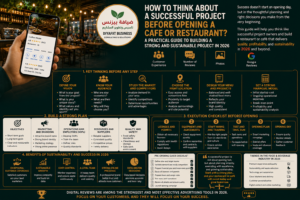
⚠️ One of the Most Common Mistakes
Imitating a successful project just because it’s popular on social media.
Some ideas succeed in Riyadh or Dubai, but may fail in other cities due to differences in: customer behaviour, competition, and market nature.
—
🎯 5 Questions You Must Answer Before Choosing the Idea:
- Who is my exact target customer? (age, income, habits)
- Is there real demand for this idea in the target area?
- How many direct competitors are there and what are their weaknesses?
- Can I operate this idea efficiently with my current budget?
- What is the one thing that will make the customer choose me specifically?
3️⃣ Market Study – Your Project’s Protective Shield
📊 How to Study the Market Correctly?
| Element | Why It Matters? | 🛠️ How to Study It? |
|---|---|---|
| Number of competitors | Understand competition size | Google Maps + field visit |
| Average prices | Determine appropriate category | Browse competitors’ menus |
| Customer ratings | Discover weaknesses | Read Google Reviews |
| Peak hours | Estimate operational volume | Visit at different times |
| Customer type | Build appropriate experience | Observe customers |
| Apps | Understand ordering behaviour | Browse delivery apps |
—
📱 Is Social Media a Sign of Success?
Some projects achieve wide reach and crowds at opening due to: influencers, photography, and marketing campaigns.
But after a few weeks: negative ratings, complaints, and weak return rates begin.
The reason: Slow operations or inconsistent quality.
The truth that many investors don’t talk about: A strong opening does not mean long-term project success. Opening brings the customer the first time, but operations determine whether they will return.
4️⃣ Financial and Operational Planning Before Opening
💰 Why Do You Need a Financial Reserve?
Many projects spend all or most of their budget on: décor, equipment, opening, and marketing.
Then they face: financial pressure after opening.
Some projects stop not because of a weak idea, but due to lack of liquidity or poor expense management.
—
✅ Golden Rule for Financial Planning:
| Item | Percentage of Budget |
|---|---|
| Establishment (decor, equipment, licenses) | 60-70% |
| Operational reserve (salaries, rent, materials) | 20-25% |
| Opening marketing | 10-15% |
Do not touch the operational reserve until after the actual opening.
—
🏠 Is Starting Small Better?
In many cases yes. A smart start helps with:
- 🧪 Testing the market
- 📉 Reducing risks
- ⚙️ Improving operations
- 📈 Building experience gradually
Starting small is safer because it reduces risk size, financial pressure, and major operational errors.
—
📋 Key Indicators to Track from Day One
Order preparation time Measure operational speed Under 7 minutes
| Indicator | Why It Matters? | 🎯 Target |
|---|---|---|
| Food Cost | Measure profitability | Below 35% |
| Average Ticket | Measure spending | 10% annual growth |
| Waste Percentage | Loss reduction | Below 3% |
| Return rate | Measure customer satisfaction | +40% |
—
⭐ How Do Google Reviews Affect Your Success?
5️⃣ Location, Design, and Identity – The Launch Trio📍 Choosing a Location – The Most Expensive Is Not Always the Best
Some investors link success to famous streets or high rents. But there are projects that succeeded in average locations and small spaces due to: strong operations, understanding customers, and good marketing.
—🎨 Identity – Why Do Some Restaurants Stick in the Mind?
Strong identity is not just about the logo or colours, but includes:
- 📸 Photography style
- 📦 Packaging
- 💬 Communication style
- ⭐ The complete customer experience
—⚙️ Design – Beautiful and Practical at the Same Time
Décor is important for first impression, but operations are what create sustainability. Successful design must be practical, comfortable, and easy to operate — not just beautiful.
6️⃣ Soft Opening and Official Opening🧪 Why Is a Soft Opening Necessary?
A soft opening helps with:
- 🧪 Testing operations
- 🎓 Training the team
- 🔍 Discovering problems
- ⭐ Improving service quality
Before the official opening and real customer pressure.
—💡 Remember: Projects that avoid major problems are those that discover errors, slowness, or weak systems before real customer pressure — not after.—👥 Employee Training – Why Is It an Investment, Not a Cost?
Weak training leads to: operational errors, waste, delays, and frequent complaints.
While well-trained teams help with: improving service speed, reducing errors, and improving customer experience.
⚠️ Common mistake: Hiring a large number quickly and without sufficient training = operational chaos, weak organization, and errors under pressure.—🛵 Delivery Apps – Design Your Restaurant for Them from the Start
Delivery apps have changed the way restaurants are designed, menus are built, and operations are managed. Today, you must think about:
- ⚡ Order preparation speed
- 📦 Packaging quality
- 🍔 Product stability after delivery
- 🚫 Operational error reduction
7️⃣ After Opening – How to Continue and Grow?📊 Data – The Fuel of Modern Restaurants
Modern projects rely on:
- 📊 Sales analysis
- 🍔 Knowing the most requested items
- ⏰ Understanding peak hours
- 👥 Customer behaviour analysis
Data-driven decisions are more accurate, faster, and more realistic than relying on expectations or personal impressions.
—📋 How to Build a Profitable Menu, Not Just a Diverse One?
A successful menu does not depend on a large number of items, but on:
- ⚡ Ease of operation
- 💰 Profitability
- 🗑️ Waste reduction
- 😊 Improving the ordering experience
Warning: Many items + complex operations = high waste + slow service + difficult oversight.
8️⃣ Two Real-Life Case Studies
🍽️ Case Study – A Restaurant in Jeddah
🔴 The Problem
The restaurant started with a very strong opening campaign, modern design, wide social media reach, and collaboration with local influencers. But after the first few weeks, problems began to appear:
- 🐌 Slow service
- ⏱️ Long waiting times for orders
- ⭐ Frequent negative ratings
- 📉 Inconsistent quality under pressure
🔍 Analysis
The problem was not food quality or location, but:
- Weak team readiness
- Complex menu
- Lack of clear operational flow within the kitchen
- Many items and overlapping tasks among employees
🟢 The Solution
- Reorganizing the menu and reducing low-demand items
- Improving operational flow within the kitchen
- Training the team on pressure scenarios
- Developing a daily monitoring system
- Improving delivery order preparation processes
- Improving customer communication speed and daily review monitoring
Return rateLowIncreased⬆️
☕ Case Study – A Café in Al Khobar
🔴 The Problem
- Good location and strong design
- But profits were not stable
- High waste
- Weak operations
- Unclear identity
🟢 The Solution
- Reorganizing the menu
- Improving operating procedures
- Developing visual identity
- Improving customer experience
Average ticket Stable Increased⬆️—
🎯 Lessons Learned from Both Case Studies
- A strong opening is not enough — operations build sustainability
- A simple, focused menu is better than a large, complex one
- Training the team on pressure scenarios protects your reputation during peak times
- Monitoring reviews daily allows problems to be solved before they escalate
- Waste is the silent killer of profits — monitor it from day one
—💀 Common Mistakes When Establishing Restaurants and Cafes
9️⃣ Conclusion
🎯 The Successful Project Formula
💰 Financial planning
🧠 Market understanding
📊 Continuous performance analysis
Successful projects are not built on enthusiasm alone or marketing hype.
A successful restaurant is not just a project that achieves a huge opening, but a project capable of: continuing, achieving profits, maintaining quality, and growing stably.
—📊 Executive Roadmap – Where to Start?1Study the market and competitors (Google Maps + visits)Before anything4Prepare your team with practical training (pressure simulation)Before opening
“To start small and grow steadily is better than to start big and collapse quickly.”
🔟 Frequently Asked Questions
Q1: What is the most important step for a successful restaurant or cafe project?
Q2: Why do some restaurants fail after opening despite crowds?
Q3: Is a market study necessary?
Q4: How do I know if a restaurant idea is suitable for the market?
Q5: Is it better to start with a small or large restaurant?
Q6: What is the importance of visual identity for restaurants?
Q7: How do Google Reviews affect restaurants?
Q8: Is design really important for project success?
Q9: How can Food Cost be reduced?
Q10: What is the importance of employee training?
Q11: Why do restaurants need a soft opening?
Q12: What are the main reasons for restaurant and café failure?
—📣 Are You Ready to Build Your Project Professionally?
Some challenges are not only related to sales, but may be related to:
Weak operations |
High costs |
Waste |
Unclear systems |
Declining customer experience
Prepared by: The Development & Operations Team, Deyafa Business
📞 Contact the Development & Operations Team
Deyafa Business provides comprehensive consulting and operational solutions: from feasibility studies and operating system design, to training and preparing projects for expansion.
Did this guide help you?
Your opinion matters to us — it helps us develop better content that suits your needs
📝 Send your feedback via the feedback form
| Rating | Impact | ||
|---|---|---|---|
| 4.7+ | ✅ High trust — customer chooses you automatically | ||
| 4.3 – 4.6 | ⚠️ Good performance — customer compares you with others | ||
| Below 4.0 | ❌ Clear trust decline — customer avoids you | ||
| Element | Impact | ||
| Ease of access | Increased visits | ||
| Parking | Customer comfort | ||
| Population density | Demand volume | ||
| Competition | Opportunity understanding | ||
| Area characteristics | Determine customer type | ||
| Strong Restaurant ✅ | Average Restaurant ❌ | ||
| Clear personality | Similar experience | ||
| Integrated experience | Ordinary packaging | ||
| Strong visual presence | Weak content | ||
| Distinctive experience | Traditional service | ||
| Indicator | Before | After 5 Months | 📈 Improvement |
| Order preparation time | 18 minutes | 8 minutes | ⬇️ 55% |
| Customer ratings | Average | Clearly improved | ⬆️ |
| Operational errors | High | Clearly decreased | ⬇️ |
| Delay complaints | Frequent | Fewer | ⬇️ |
| Indicator | Before | After 4 Months | 📈 Improvement |
| Waste | High | Decreased | ⬇️ |
| Customer ratings | Average | Better | ⬆️ |
| Service speed | Fluctuating | More stable | ⬆️ |
| Step | Action | ⏱️ Timing | |
| 2 | Create a realistic financial plan + 6-month reserve | Before spending | |
| 3 | Build a simple menu focused on profits | Establishment phase | |
| 5 | Open with a soft opening first | 2-4 weeks | |
| 6 | Track your indicators daily from day one | Continuous |
📣 Do You Need to Build a Professional Training Program for Your Team?
Some challenges inside restaurants and cafes are not only related to sales, but also related to:
Weak operations
High costs
Waste reduction
Unclear systems
Declining customer experience
Prepared by: The Development & Operations Team at Deyafa Business
📞 Contact the Development & Operations Team
Deyafa Business provides consulting and operational solutions based on analysis, practical experience, and understanding of market nature, including building integrated training programs for teams.
Did this guide help you?
Your opinion matters to us — it helps us develop better content that suits your needs
Our clients’ trust is our success
