
Restaurant or Cafe Feasibility Study 2026: How to Build a Professional Study That Reduces Losses and Helps Achieve Profits?
Restaurant & Cafe Encyclopedia — Deyafa Business
Consultants for Restaurant & Cafe Establishment and Development
Specialized Content in Operating, Developing, and Managing Food Projects & Building More Efficient and Stable Operating Systems
- Why Is a Feasibility Study More Important Than Enthusiasm?
- What Is a Real Feasibility Study?
- Market Study – The Foundation on Which Everything Is Built
- Financial Study – The Numbers That Don’t Lie
- Operational and Technical Study – Is Your Project Feasible?
- Risk Analysis and Financial Reserve
- Two Case Studies – A Restaurant in Riyadh and a Cafe in Sheikh Zayed
- The Future of Feasibility Studies 2026
- Conclusion
- Frequently Asked Questions
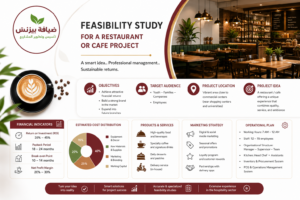
1️⃣ Why Is a Feasibility Study More Important Than Enthusiasm?
💡 A Statistic That Makes You Pause:
82% of restaurants that fail within the first two years had “great enthusiasm” at the start, but only 9% of them had a realistic feasibility study. The difference between enthusiasm and study is the difference between gambling and investing.
Restaurant and cafe feasibility studies are no longer just a file of numbers or sales estimates, but have become an essential step that helps investors:
Who are your actual customers?
What are their weaknesses?
Not just establishment
What if things don’t go as planned?
Not just for opening
Many projects start with great enthusiasm, then face financial pressure and weak liquidity — not only because of a weak idea, but due to the absence of a professional, realistic feasibility study.
📖 What Is a Restaurant or Cafe Project Feasibility Study? (Brief Definition)
A restaurant and cafe feasibility study is a comprehensive analysis of the market, costs, operations, expected profits, and potential risks, conducted before starting the project to reduce random decisions, estimate real chances of success, and build a realistic financial and operational plan that ensures project continuity and profitability. The study includes five main axes: market study, financial study, operational study, technical study, and risk analysis.
⚠️ Why Is a Feasibility Study Your Protective Shield?
A feasibility study helps with:
- 🚫 Reducing random decisions
- 📊 Understanding actual costs
- 📈 Analyzing chances of success
- 🛡️ Estimating risk size before investing
🤔 The Smart Investor’s Question…
If someone asked you: “How much will you profit in the first 12 months? And how much do you need to cover your monthly expenses?”
Is your answer accurate with numbers, or just a guess?
A smart investor doesn’t say “I guess.” They say “I calculated.”
The difference between guessing and studying:
- Guessing: “I think sales will be 200,000 per month”
- Study: “By analyzing 5 competitors in the same area, their average sales are X, and our price is 10% lower, so we expect Y sales in the first 3 months, rising to Z after building a customer base”
Study = numbers based on evidence, not wishes.
2️⃣ What Is a Real Feasibility Study?
It is an analytical study that includes:
- 🧠 The market — its size, trends, gaps
- 🔍 Competitors — their strengths and weaknesses
- 💰 Costs — establishment and operations
- ⚙️ Operations — how the project will work daily
- 📈 Expected profits — in optimistic, realistic, and pessimistic scenarios
- ⚠️ Potential risks — and how you will deal with them
The goal of a feasibility study is not just to give optimistic numbers, but to build realistic expectations, reduce surprises, and improve the project’s chances of success.
📋 The Difference Between a Feasibility Study and an Operations Plan
| Feasibility Study | Operations Plan |
|---|---|
| Evaluates the project before execution | Manages the project after opening |
| Cost analysis | Operations organization |
| Profit estimation | Performance monitoring |
| Risk study | Quality improvement |
🔴 Why Do Some Projects Fail Despite Having a Feasibility Study?
Because some studies are:
- 📚 Too theoretical — not connected to market reality
- 🎯 Based on unrealistic expectations — exaggerated sales
- ⚙️ Doesn’t consider real operational nature — ignoring waste and hidden costs
⚠️ What Some Don’t Notice:
Some investors exaggerate sales estimates or reduce expenses, which later leads to a liquidity crisis or rapid financial pressure after opening.
💀 Common Mistakes When Preparing a Feasibility Study
| Mistake | Impact |
|---|---|
| Unrealistic sales estimates | Wrong financial decisions |
| Ignoring operational costs | Weak profits |
| Poor competitor analysis | Difficulty competing |
| Choosing an unsuitable location | Weak sales |
| Liquidity pressure | No financial reserve |
| Ignoring operations | Operational chaos |
3️⃣ Market Study – The Foundation on Which Everything Is Built
A market study helps with:
- 🔍 Understanding competitors
- 👥 Analyzing customers
- 💡 Discovering opportunities
- 🛡️ Reducing risks
📊 How to Study the Market Correctly?
Peak hours Estimate operational volume Visit at different times
| Element | Why It Matters? | 🛠️ How to Study It? |
|---|---|---|
| Number of competitors | Measure market strength | Google Maps + field visits |
| Average prices | Determine appropriate category | Browse competitors’ menus |
| Customer ratings | Understand competitors’ problems | Read Google Reviews |
| Area characteristics | Determine customer type | Observe customers |
| Delivery apps | Understand ordering behavior | Browse delivery apps |
💡 The truth that many investors don’t talk about:
A project’s success in Riyadh or Jeddah does not necessarily mean it will succeed in another city or different area.
Why? Due to differences in: purchasing power, customer behavior, competition, and population density.
4️⃣ Financial Study – The Numbers That Don’t Lie
💰 The Most Important Part of a Feasibility Study
The financial study helps with:
📉 Estimating expenses
📈 Calculating profits
🎯 Break-even analysis
📋 Key Elements of the Financial Study
| Element | Goal |
|---|---|
| Establishment cost | Know investment size |
| Operational expenses | Estimate monthly costs |
| Expected revenue | Forecast sales |
| Break-even point | Know when costs are covered |
| Expected profits | Evaluate project viability |
| Cash flows | Measure financial stability |
📊 Healthy Ratios for Restaurants and Cafes
Waste Below 2%+5%
| Indicator | Healthy Range | ⚠️ Danger Zone |
|---|---|---|
| Food Cost | 28% – 35% | +40% |
| Labor Cost | 20% – 25% | +30% |
| Rent Ratio | 14% – 18% | +22% |
| EBITDA Margin | 15% – 25% | Below 10% |
🚨 Why Do Some Projects Fail Financially Despite Crowds?
Because high sales don’t always mean high profits.
Some restaurants suffer from: high waste, weak oversight, or high operational costs.
🎯 Exercise: Calculate Your Project’s Break-Even Point
Break-even point (monthly) = Total monthly expenses ÷ Average profit margin per order
Example: If your expenses are 80,000 SAR and your profit margin is 40%, you need 200,000 SAR in monthly sales just to cover your costs.
Do you know your break-even number now? If not, you’re walking in the dark.
5️⃣ Operational and Technical Study – Is Your Project Feasible?
⚙️ What Does the Operational Study Include?
| Element | Goal |
|---|---|
| Staff distribution | Operations organization |
| Work procedures | Quality standardization |
| Inventory management | Waste reduction |
| Quality control | Experience improvement |
| Order organization | Efficiency increase |
Weak operations or daily chaos can lead to: waste, slow service, and lower profits — even if the market study is excellent.
🏗️ Technical and Engineering Study
Includes:
- 📐 Space distribution
- 🍳 Kitchen design
- 🏃 Operational flow
- 🌬️ Ventilation systems
- 😊 Customer experience
📍 Location Study
Location directly affects: number of customers, sales, accessibility, and project visibility.
Is the most expensive location the best? Not always. Some projects succeeded due to good operations, marketing, and experience quality — not just because of a high-cost location.
6️⃣ Risk Analysis and Financial Reserve
⚠️ Examples of Potential Risks
| Risk | Impact | 🛡️ How to Protect Yourself? |
|---|---|---|
| Price increases | Increased costs | Diversify suppliers |
| Weak sales | Financial pressure | Backup marketing plan |
| Strong competition | Lower market share | Clear differentiation |
| Weak operations | Complaints and losses | SOPs and training |
| Liquidity shortage | Project struggles | 6-month reserve |
💰 Why Is a Financial Reserve Necessary?
Because the first months of operation are often unstable, full of trials, and require financial flexibility.
In many projects, real pressure begins after opening, not before.
7️⃣ Two Real-Life Case Studies
🍽️ Case Study – A Restaurant in Riyadh
🔴 The Problem
The restaurant started with a feasibility study based on high sales estimates and inaccurate operating costs. After opening, the following appeared:
- 💸 Liquidity crisis
- 📈 High operating costs
- 📉 Weak profit margins
🔍 Analysis
It was found that the study:
- Did not account for actual waste
- Did not include sufficient financial reserve
- Also exaggerated daily order forecasts
🟢 The Solution
- Rebuilding the financial study
- Improving pricing
- Reducing waste
- Reorganizing operations
Operating cost High Decreased⬇️
☕ Case Study – A Cafe in Sheikh Zayed
🔴 The Problem
- Strong location and luxurious design
- But the feasibility study did not study customer behavior, competition strength, or actual operating costs
🔍 Analysis
- Prices were not suitable for the target audience
- Complex menu
- Operations consumed high costs
🟢 The Solution
- Menu modification
- Cost redistribution
- Operations improvement
- Pricing strategy development
| Indicator | Before | After 6 Months | 📈 Improvement |
|---|---|---|---|
| Waste | High | Lower | ⬇️ |
| Profits | Unstable | Better | ⬆️ |
| Cash flows | Weak | More stable | ⬆️ |
| Indicator | Before | After 5 Months | 📈 Improvement |
|---|---|---|---|
| Food Cost | High | Decreased | ⬇️ |
| Average Ticket | Low | Increased | ⬆️ |
| Return Rate | Weak | Improved | ⬆️ |
| Profits | Fluctuating | More stable | ⬆️ |
🎯 Lessons Learned from Both Case Studies
- Realistic sales estimates are more important than optimistic forecasts
- Actual waste must be accounted for from the beginning
- Financial reserve is not a luxury — it’s a lifeline
- A simple menu costs less and is easier to operate
- Reviewing the feasibility study 6 months after opening is essential for course correction
💀 Common Psychological Mistakes When Preparing a Feasibility Study
8️⃣ The Future of Feasibility Studies 2026
🤖 How Has the Feasibility Study Changed?
It has become more dependent on:
📈 Continuous analysis
📱 App studies
👥 Digital customer behavior
Modern projects rely on: smart analysis, operational forecasts, performance monitoring, and continuous financial analysis — instead of just traditional estimates.
📊 Key Performance Indicators to Monitor
| KPI | Why It Matters? | 🎯 Target |
|---|---|---|
| Average Ticket | Measure spending | 10% annual growth |
| Food Cost | Measure profitability | Below 35% |
Waste Percentage Reduce losses Below 2%Ticket Time Improve operations Under 7 minutes Return Rate Measure customer satisfaction+40%
9️⃣ Conclusion
🎯 A Feasibility Study Is Not a Luxury
⚠️ Risk analysis
🏗️ Building a stable project
💰 Sustainable profitability
Successful projects always start with: realistic planning, accurate study, and organized operations — not just enthusiasm or marketing hype.
📊 Executive Roadmap – Build Your Study Now
| Step | Action | ⏱️ Timing |
|---|---|---|
| 1 | Study the market and competitors (Google Maps + field visits) | Week 1-2 |
| 2 | Build the financial model (3 scenarios) | Week 2-3 |
| 3 | Analyze actual operational costs | Week 3 |
| 4 | Create a risk plan + financial reserve | Week 4 |
| 5 | Review the study with an expert before execution | Week 4 |
“A feasibility study does not guarantee success, but it reduces failure to the minimum possible.“
🔟 Frequently Asked Questions
Q1: What is the importance of a restaurant or cafe feasibility study?
Q2: Does a feasibility study guarantee project success?
Q3: Why do some projects fail despite having a feasibility study?
Q4: Is a feasibility study necessary for small projects?
Q5: What is the difference between a feasibility study and an operations plan?
Q6: Is location alone enough for restaurant success?
Q7: Why do projects need a financial reserve?
Q8: What is the most common mistake investors make?
Q9: How does competitor analysis help?
Q10: What is the importance of a soft opening?
Q11: Can small projects achieve strong profits?
Q12: Why is data important in modern feasibility studies?
📣 Do You Need a Professional Feasibility Study for Your Project?
Some challenges are not only related to sales, but may be related to:
Weak operations |
High costs |
Waste |
Unclear systems |
Declining customer experience
Managing and Operating Restaurants and Cafes 2026: How to Build a Professional Operating System
📞 Contact the Development & Operations Team
Deyafa Business provides feasibility study and financial analysis services, operating system design, and training — all based on analysis and practical experience.
Did this guide help you?
Your opinion matters to us — it helps us develop better content that suits your needs
Our clients’ trust is our success
