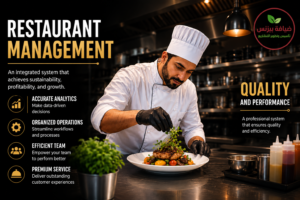
Restaurant and Cafe Management and Operations 2026: How to Build a Professional Operating System

Restaurant & Cafe Encyclopedia — Deyafa Business
Consultants for Restaurant & Cafe Establishment and Development
Specialized Content in Operating, Developing, and Managing Food Projects

1️⃣ Why Did the Rules of the Game Change in 2026?

💡 Did you know?

85% of restaurants that close within the first 3 years did not suffer from weak sales, but from weak internal operating systems. Customers were coming, but profits were leaking through gaps no one saw.

Restaurant and cafe management and operations no longer depend only on food quality, marketing strength, or design beauty, but have become a complex operational process that requires:

📋 Clear systems
Documenting every procedure
🔍 Daily oversight
Continuous performance monitoring
📊 Financial analysis
Reading numbers intelligently
🎓 Continuous training
Investing in the team
Customer experience monitoring
The customer is the measure

🤔 Think with me…

Imagine you own a restaurant that achieves monthly sales of 500,000 SAR. If your Food Cost is 42% instead of 35%, how much do you lose monthly?

Answer: You lose 35,000 SAR monthly!

Difference: 42% – 35% = 7%
Monthly loss: 500,000 × 7% = 35,000 SAR
Annual loss: 420,000 SAR 💸

This amount could be a general manager’s salary or an entire annual marketing budget!

Many projects achieve:

  • ✅ Good sales
  • ✅ Clear visibility

But internally suffer from:

  • ❌ Weak profits
  • ❌ Operational chaos
  • ❌ High waste
  • ❌ Quality variation between branches and shifts

🎯 Early Conclusion

The strongest projects in 2026 now rely on:

📊 Organized operations  |
📈 Continuous analysis  |
📋 Clear operating systems

More than relying on individual efforts or random management.

2️⃣ The Difference Between a Crowded Restaurant and a Profitable Restaurant

Crowds do not always mean financial success. This truth may be shocking to many investors.

⚠️ Warning Signs: When Are Crowds Deceptive?

Some projects achieve high sales but suffer from:

  • 🔴 High Food Cost
  • 🔴 Frequent errors
  • 🔴 Slow operations
  • 🔴 Weak productivity

🔍 Indicators of Weak Operations

ProblemImpact🔧 Quick Solution

Order delays Decreased customer satisfaction Workflow planning
Quality variation Loss of trust Recipe standardization
Many complaints Declining ratings Daily training
High waste Weak profits Weekly inventory
Weak training Increased errors Training program
Lack of oversight Operational chaos Monitoring checklists

“Crowds hide the wounds, but numbers reveal them.” — From the practical experience of the Deyafa Business team

✅ Quick Checklist: Is Your Restaurant Just Crowded or Also Profitable?

  • ☐ I know the profit margin of each item on the menu
  • ☐ I conduct weekly inventory
  • ☐ I calculate Food Cost monthly
  • ☐ I track customer ratings weekly
  • ☐ I have a clear system for receiving complaints
  • ☐ My net profit is at least 15% of sales

📊 Your Review Result:

Less than 3 ✅ = High risk | 4-5 ✅ = Average performance | 6 ✅ = Excellent performance

3️⃣ Operating Systems: The Backbone of the Project

Why Do Restaurants Need Clear Operating Systems?

🎯 Quality Standardization
The same taste every day
🚫 Reduce Individual Efforts
No randomness in work
Training Speed
Faster employee qualification
📈 Operational Efficiency
Fewer resources, better results
🛡️ Error Reduction
Fewer errors daily

Professional projects do not rely only on people, but on systems.

📋 What Are Standard Operating Procedures (SOPs)?

Standard Operating Procedures are:
Clear written instructions that explain:

  1. 📝 Detailed work steps
  2. 🍳 Precise preparation methods
  3. 🤵 Required service style
  4. ✅ Specific quality standards
  5. 🚨 Mechanism for handling operational problems

How Do SOPs Help Stabilize Quality?

Element Impact 📈 Expected Improvement Rate
Workflow standardization Quality consistency +40%
Easier training Faster employee qualification +60%
Error reduction Loss reduction +35%
Task clarity Reduced chaos +50%
Improved oversight Performance stability +45%

💡 What some don’t notice

Some investors believe the problem is with the employees, while the real problem is sometimes: the absence of the system itself.

An employee cannot deliver consistent performance in an environment that is:

  • ❌ Disorganized
  • ❌ Changing daily
  • ❌ Full of random decisions

Ask yourself: If you put the best employee in the world in a chaotic environment, will they deliver their best performance?

4️⃣ Organizational Structure: From Chaos to Discipline

Why Does the Absence of an Organizational Structure Cause Major Problems?

  • 🔴 Decisions become random
  • 🔴 Responsibilities overlap
  • 🔴 The root causes of errors are not tracked

🏗️ Model of an Organized Organizational Structure

👨‍💼 General Manager
📋 Operations Management
Daily operations monitoring
🍳 Kitchen
Quality and production
🤵 Service
Customer experience
📦 Procurement
Costs and inventory
💰 Financial Control
Analysis and monitoring
📣 Marketing
Visibility and reach

🎯 Practical Exercise

Draw your project’s current organizational structure on paper. Then answer:

  1. Does every employee know who they report to?
  2. Is there any overlap in authority between any two roles?
  3. Are there key responsibilities not covered by anyone currently?

5️⃣ Daily Monitoring: Your Eye That Never Sleeps

Daily monitoring helps with:

  • 🔍 Early problem detection
  • ✅ Quality monitoring
  • 📈 Performance improvement
  • 💰 Operational loss reduction

📋 What Should Be Monitored Daily?

Service speedExperience improvementOrder timer

Element Goal 📊 Suggested Monitoring Tool
Sales Performance measurement Daily POS report
Waste Loss reduction Daily waste log
Customer ratings Satisfaction measurement Daily Google review check
Product quality Maintaining consistency Quality inspection checklist
Inventory Prevent shortages and waste Quick daily count

6️⃣ Food Cost: The Silent Killer of Profits

🚨 Why Is Food Cost One of the Most Dangerous Indicators?

High Food Cost is one of the biggest causes of weak profits in restaurants.

Some projects achieve good sales but lose money due to:

  • ❌ Poor storage
  • ❌ Preparation errors
  • ❌ Weak inventory
  • ❌ Lack of consumption oversight

📊 Healthy Food Cost Ratios by Business Type

Business Type Healthy Range ⚠️ Danger Zone
Fast Food Restaurants 35% – 45% Above 48%
Cafes 25% – 33% Above 38%
Fine Dining Restaurants Depends on operations Per internal standards

How Does Regular Inventory Help Reduce Losses?

🔍 Detect discrepancies
Compare actual vs. expected
🛡️ Reduce theft
Oversight prevents violations
📦 Control consumption
Know usage rates
🛒 Improve purchasing
Order appropriate quantities

In many projects, the problem is not high prices, but poor oversight, weak monitoring, or lack of real number analysis.

7️⃣ Key Performance Indicators: The Language of Numbers That Never Lies

Why Do You Need Operational KPIs?

Operational indicators help management:

  • 📊 Measure actual performance
  • 🔍 Discover weaknesses
  • 🎯 Improve decisions

📈 Most Important KPIs in Restaurants and Cafes

Return RateMeasure customer loyaltyAbove 40%

KPI Why It Matters? 🎯 Target Rate
Average Ticket Measure average spending +10% annually
Order Preparation Time Measure operational speed Under 12 minutes
Waste Percentage Measure efficiency Below 3%
Customer Ratings Measure experience quality 4.5+ stars
Labor Cost Expense control 25-30% of revenue

⚡ Why Do Some Restaurants Collapse During Rush Hours?

Peak times reveal the true operational strength. Some projects collapse during rush hours due to:

  • Poor task distribution
  • Weak training
  • Lack of organization

Signs of weak operations under pressure:

  • 🚨 Order delays
  • 😰 Staff tension
  • ❌ Frequent errors
  • 📉 Quality drop
  • 📝 Increased complaints

🎓 How Does Training Help Stabilize Operations?

A trained team helps with:

  • ✅ Error reduction
  • ⚡ Speed improvement
  • ⭐ Service quality improvement
  • 😊 Customer experience improvement

Training is not a luxury

Some projects consider it: An extra cost

Professional projects consider it: A direct investment

⭐ Why Is Customer Experience an Essential Element?

Today’s customer evaluates not just the food, but:

  1. 🕐 Service speed
  2. 🧹 Cleanliness
  3. 🪑 Comfort
  4. 😊 Handling manner
  5. 🎯 The complete experience

🧠 Interesting Fact

Often, customers don’t remember product details as much as they remember:

  • How they felt inside the place
  • The speed of the experience
  • How they were treated

The question you should ask yourself: What feeling do your customers leave with after each visit?

📱 How Do Google Reviews Affect Sales?

Many customers decide to try a restaurant based on:

  • ⭐ Average rating
  • 📸 Photos
  • 📝 Number of reviews
  • 💬 Previous customer experiences
Rating Expected Impact 📊 Probability of New Customer Visit
4.7+ High trust 85%+
4.3 – 4.6 Good performance 60-75%
Below 4.0 Clear trust decline Below 40%

🤖 Why Has Technology Become an Important Element?

Modern restaurants now rely on:

  • 💻 POS systems
  • 📦 Inventory management
  • 📊 Monitoring dashboards
  • 🧠 Smart data analysis

Monitoring DashboardsPerformance monitoringImmediate

System Benefit ⚡ Speed of Impact
POS Order organization Immediate
Inventory Management Waste reduction 30-60 days
Financial Analysis Decision improvement 90 days
Smart Forecasting Planning improvement 60-90 days

8️⃣ Real-Life Case Studies

🔴 The Problem

The restaurant was achieving:

  • Daily crowds
  • Good sales

But profits were weak due to:

  • High waste
  • Slow operations
  • Weak oversight

🟢 The Solution

  1. Building a clear operating system
  2. Developing work procedures
  3. Training the team
  4. Improving inventory
  5. Developing daily oversight

Results within 5 months:

Indicator Before After 📈 Improvement
Waste 9% 3% ⬇️ 67%
Order preparation time 14 minutes 7 minutes ⬇️ 50%
Customer ratings Average Clear improvement ⬆️ Excellent
Profits Unstable More stable ⬆️ Stable

☕ Case Study – A Cafe in New Cairo

🔴 The Problem

The cafe had:

  • Good design
  • Strong location

But operations were:

  • Unstable
  • Quality varying
  • Experience inconsistent

🟢 The Solution

  • Training development
  • Operating procedures improvement
  • Menu reorganization
  • Daily oversight improvement

Results:

Indicator Before After 📈 Improvement
Customer return rate Low +31% ⬆️ 31%
Service speed Slow Notable improvement ⬆️ Significant
Customer ratings Average Better ⬆️ Excellent
Quality stability Weak More consistent ⬆️ Stable

9️⃣ Conclusion and Recommendations

🎯 Final Conclusion

Restaurant and cafe management and operations in 2026 now depend on:

📋 Systems
📊 Analysis
🔧 Organized operations
🎓 Training
🔍 Daily oversight

More than relying on: ❌ Enthusiasm or ❌ Random management

📊 The Difference Between Organized and Random Projects

Organized Project ✅ Random Project ❌ 📈 Result Difference
Consistent experience Quality variation 40% higher customer satisfaction
Clear systems Weak training 50% higher operational efficiency
Continuous analysis Random decisions 25-35% higher profits
Better oversight Frequent complaints Two stars higher ratings
Easier growth Difficult expansion Greater scalability

Projects that have clear operations, consistent quality, and continuous analysis are more capable of achieving profits, retaining customers, and expanding in a stable and sustainable manner.

❓ Frequently Asked Questions

Q1: What is the importance of having a clear operating system in restaurants?

It helps with: quality standardization, error reduction, and improving operational speed and efficiency.

Q2: Does crowd mean financial success for a restaurant?

Not always, because some restaurants achieve high sales but suffer from high costs, weak oversight, or low real profitability.

Q3: Why is Food Cost an important indicator?

Because unmanaged high Food Cost can lead to weak profits and increased operational losses.

Q4: How does technology help improve operations?

By organizing orders, reducing errors, improving analysis, and increasing daily management efficiency.

Q5: Do small projects need operating systems?

Yes, because small projects are quickly affected by any error, waste, or weak operations. Systems are important at any size.

Q6: What are the main reasons for restaurant operational failure?

Among the most prominent reasons: absence of systems, weak training, poor oversight, and failure to professionally monitor numbers.

📣 Are You Ready to Build Your Project Professionally?

Deyafa Business Services and Solutions for Establishing, Developing, and Operating Restaurants and Cafes

Some challenges inside restaurants and cafes are not only related to sales or product quality, but may be related to:

Weak operations
High costs
Waste
Unclear systems
Declining customer experience

Prepared by: The Development & Operations Team, Deyafa Business

🆕 New Project Services

  • 📊 Feasibility study and financial analysis
  • 🎯 Concept and operational identity development
  • 📋 Operating systems and procedures design
  • 🏗️ Kitchen and cafe planning and setup
  • 📝 Menu development and pricing
  • 🎓 Training and preparation before opening
  • 📈 Operational and growth plan preparation

🔄 Existing Project Services

  • 🔍 Operational problem analysis and diagnosis
  • 💰 Profitability improvement and waste reduction
  • ⭐ Operational and service quality development
  • 🏗️ Operational and management restructuring
  • 😊 Customer experience improvement
  • 📊 Financial and operational performance development
  • 📈 KPI and monitoring system development
  • 🚀 Preparing projects for expansion or franchising

📞 Contact the Development & Operations Team

We appreciate your interest in your project. We offer general consultations to answer basic questions. Specialized solutions and advanced operational strategies fall within our professional consulting services.


📣 Do You Need to Build a Professional Training Program for Your Team?

Some challenges inside restaurants and cafes are not only related to sales, but also related to:

Weak operations
High costs
Waste reduction
Unclear systems
Declining customer experience

Prepared by: The Development & Operations Team at Deyafa Business

📞 Contact the Development & Operations Team

Deyafa Business provides consulting and operational solutions based on analysis, practical experience, and understanding of market nature, including building integrated training programs for teams.

Leave a Comment

Your email address will not be published. Required fields are marked *

  • Rating
Scroll to Top
Messenger