
Restaurant and Cafe Profits 2026: How to Increase Your Project’s Profits Professionally and Sustainably
Restaurant & Cafe Encyclopedia — Deyafa Business
Consultants for Restaurant & Cafe Establishment and Development
Specialized Content in Operating, Developing, and Managing Food Projects & Building More Efficient and Stable Operating Systems
- Why Has Real Profitability Become Harder in 2026?
- Where Do Restaurant and Cafe Profits Get Lost? (Leakage Map)
- What Is the Average Profit for Restaurants and Cafes?
- 8 Strategies to Actually Increase Your Restaurant’s Profits
- Technology and Artificial Intelligence in Service of Profitability
- Real-Life Case Studies
- Conclusion and Recommendations
- Frequently Asked Questions
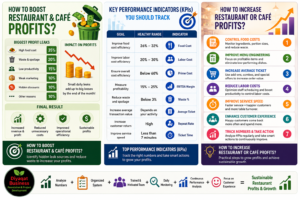
1️⃣ Why Has Real Profitability Become Harder in 2026?
💡 Did you know?
68% of restaurants with monthly sales exceeding 200,000 SAR have a net profit margin of less than 8%. The reason is not weak sales, but profit leakage through daily operational and administrative gaps that many owners fail to notice.
Increasing restaurant and cafe profits does not depend only on increasing customer count or raising sales, but on:
Managing expenses
Higher efficiency
Fewer losses
Better productivity
Loyalty and return
Based on numbers
Many projects appear crowded but suffer from weak profitability due to hidden problems in operations, management, and pricing.
📊 Healthy Profitability Ratios for Restaurants and Cafes 2026
| Indicator | Healthy Range | ⚠️ Danger Zone | 📝 Description |
|---|---|---|---|
| Food Cost | 25% – 39% | +42% | Percentage of raw material cost from total sales |
| Labor Cost | 16% – 25% | +30% | Percentage of salaries and wages from total sales |
| Prime Cost | Below 60% | +65% | Food Cost + Labor Cost — most important profitability indicator |
| EBITDA Margin | 15% – 25% | Below 10% | Net profit before interest, taxes, depreciation |
| Waste Percentage | Below 2-3% | +5% | Percentage of spoiled or unused products |
| Rent Ratio | 12% – 15% | +18% | Percentage of rent from total monthly sales |
⚠️ If any indicator exceeds the danger zone, profits are at risk even if sales are high.
📉 What Has Changed in the Market?
In past years, some restaurants and cafes could achieve good results simply by:
But today’s market has become more complex due to:
⚠️ Factors Putting Pressure on Profitability in 2026
For this reason, intelligent profit management has become more important than just achieving high sales.
🤔 Think with me…
A restaurant achieves monthly sales of 300,000 SAR with a net profit margin of 7%.
Another restaurant on the same street achieves sales of 220,000 SAR with a net profit margin of 18%.
Which restaurant owner sleeps peacefully at the end of the month?
Answer: The second restaurant owner!
First restaurant: 300,000 × 7% = 21,000 SAR net profit
Second restaurant: 220,000 × 18% = 39,600 SAR net profit
The second restaurant makes 88% more profit even though its sales are 80,000 SAR lower! 🧠
Lesson: Sales are an illusion if they don’t translate into real profits.
💡 Real example:
Some restaurant owners feel happy when they see daily crowds at their project, but they are surprised at the end of the month that profits are much lower than expected.
The reason is often not weak sales, but the existence of continuous profit leakage within daily operations without clear notice.
2️⃣ Where Do Restaurant and Cafe Profits Get Lost? (Leakage Map)
🔴 Why Do Some Crowded Restaurants Not Achieve Strong Profits?
One of the biggest misconceptions in the restaurant and cafe industry is:
While the reality is that some projects:
✅ What people see:
- 📊 High sales
- 📋 Many orders
- 📱 Strong social media presence
- 👥 Daily crowds
❌ What is hidden from people:
- 📈 High Food Cost
- 💸 Weak pricing
- 🗑️ Continuous waste
- 👥 Excess labor
- 🔍 Weak oversight
- 📉 Low profit margin
🗺️ Profit Leakage Map
| Problem | Impact on Profits | 🔧 Corrective Action |
|---|---|---|
| High Food Cost | Reduces profit margin | Menu engineering |
| Waste and spoilage | Continuous daily losses | Weekly inventory |
| Excess labor | Higher operating expenses | Shift productivity analysis |
| Slow service | Lost customers and sales | Workflow improvement |
| Random discounts | Weak profitability | Clear discount policy |
| Weak inventory | Product loss and lack of control | Periodic inventory system |
| Poor purchasing | Increased cost | Supplier comparison |
| Weak operations | Errors and extra costs | Standard operating procedures |
💸 Profit Leakage
Some losses are not immediately obvious, but they drain profits daily.
🧾 Cashier errors
🦠 Product spoilage
📦 Weak inventory
🐌 Slow service
👥 Excess labor
🏷️ Unplanned discounts
🛒 Poor purchasing management
✅ Exercise: Calculate Profit Leakage in Your Project
Choose one week and monitor:
- How many orders were remade? × order cost = ______ SAR
- How many spoiled products in storage this week? × cost price = ______ SAR
- How many extra hours without clear productivity? × hourly wage = ______ SAR
- How many discounts given without justification? = ______ SAR
Weekly total × 52 weeks = Your annual leakage loss!
You may be surprised that the number is in the thousands of riyals! 💸
3️⃣ What Is the Average Profit for Restaurants and Cafes?
| Type of Business | Average Profit Margin | 📊 Performance Assessment |
|---|---|---|
| Specialty Cafes | 18% – 30% | ✅ Excellent if above 25% |
| Fast Food Restaurants | 13% – 25% | ✅ Good if above 20% |
| Family Restaurants | 10% – 20% | ⚠️ Needs improvement if below 15% |
| Bakeries & Desserts | 20% – 32% | ✅ Excellent if above 28% |
💰 The Difference Between Revenue and Real Profit
Some project owners focus only on:
- 📊 Sales volume
- 📋 Number of orders
- 👥 Crowds
- 🔢 Number of customers
But real profit depends on:
🧠 A Financial Fact That May Shock You
A restaurant achieving annual revenue of 1 million SAR with a net profit margin of 5% = only 50,000 SAR profit.
At the same time, another restaurant achieving 600,000 SAR annually with a margin of 20% = 120,000 SAR profit.
The “smaller” restaurant makes 140% more profit!
4️⃣ 8 Strategies to Actually Increase Your Restaurant’s Profits
📊 Strategy 1: Controlling Food Cost
🚨 Food Cost is one of the most important profitability elements
Healthy range: between 26% and 36%
How to reduce Food Cost?
📋 Strategy 2: Menu Engineering
Some products achieve high sales but have low profit margins. Meanwhile, other products generate higher profits but are not highlighted well on the menu.
How does menu engineering help increase profits?
Place them in visual focus areas
Eliminate low-margin products
The eye lands on specific spots first
Without shocking the customer
Direct additional profit source
🧠 Strategy 3: Psychology of Pricing
The way a price is displayed affects the purchase decision.
Practical examples:
- 🔢 18 instead of 20 (a 2-riyal difference but a big psychological impact)
- 👁️ Place highest-profit products in the top right corner of the menu
- 📦 Use bundle offers (combos) to increase average check
- ☕ Highlight the larger size in a way that makes the price seem more valuable
📈 Strategy 4: Raising Average Ticket
🧠 Important fact: Increasing the number of customers is not necessarily required to increase profits.
Some projects increase profits through:
- 🔼 Upselling
- ➕ Add-ons
- 🎯 Smart offers
- 🗣️ Trained staff recommendations
Example: If your average ticket is 45 SAR and you have 100 customers daily, raising the average to 52 SAR (just +7 SAR) means a monthly increase of 21,000 SAR without any new customers!
🎯 Practical Exercise: Increasing Average Ticket
This week, train your service team on just one phrase:
“With this dish, I recommend you try the ___ add-on, many customers love it!”
Measure the average ticket before and after this week, and notice the difference.
👥 Strategy 5: Reducing Labor Cost
| Indicator | Healthy Range | ⚠️ Danger Zone |
|---|---|---|
| Labor Cost | 20% – 30% | Above 33% |
| Prime Cost | Below 60% | Above 65% |
| EBITDA Margin | 15% – 25% | Below 10% |
How to improve labor cost?
⚡ Strategy 6: Improving Service Speed
Slow service not only affects customer satisfaction but directly impacts:
- 📋 Number of orders
- 🪑 Table turnover
- 🛵 Delivery
- 💰 Daily sales
🎯 Healthy Ticket Time: Less than 7 minutes
⭐ Strategy 7: Improving Customer Experience
The customer who returns consistently is more profitable than a new customer.
Customer Retention helps with:
📊 Strategy 8: Controlling Prime Cost
🧮 Prime Cost = Food Cost + Labor Cost
Healthy range: Below 60%
If it rises significantly:
❌ Profits begin to erode — even with good sales
📈 Key KPIs to Monitor for Increasing Profits
| KPI | Healthy Range | 🛠️ Measurement Tool |
|---|---|---|
| Food Cost | 26% – 32% | Monthly food cost report |
| Labor Cost | 20% – 30% | Payroll and productivity report |
| Prime Cost | Below 60% | Financial dashboard |
| EBITDA Margin | 15% – 25% | Income statement |
| Waste Percentage | Below 3% | Daily waste log |
| Average Ticket | Depends on business type | POS report |
| Repeat Rate | High | Loyalty program |
| Ticket Time | Under 7 minutes | Kitchen Display System (KDS) |
—
📋 Quick Checklist: Are Your Profits Under Control?
- ☐ I know my Food Cost this month
- ☐ I know my Labor Cost this month
- ☐ Prime Cost is below 60%
- ☐ Waste is below 3%
- ☐ Average ticket is gradually increasing
- ☐ Order preparation time is under 7 minutes
- ☐ I have a weekly profit dashboard
How many ✅ did you achieve?
Less than 4 = Urgent plan needed | 5-6 = Good performance, improvable | 7 = Excellent control
5️⃣ Technology and Artificial Intelligence in Service of Profitability
🧠 Smart Kitchens
Smart kitchens have become one of the most important development trends for restaurants and cafes in 2026.
| System | Benefit | ⚡ Impact on Profitability |
|---|---|---|
| Kitchen Display System | Order organization | Reduce preparation errors by 40% |
| Smart Routing | Order distribution within kitchen | Increase service speed by 25% |
| Auto Alerts | Delay notifications | Reduce customer complaints |
| Production Tracking | Monitor execution speed | Improve efficiency by 30% |
| Heat Mapping | Operational flow analysis | Better labor distribution |
🤖 AI Cost Control – Smart Cost Control
AI Cost Control systems help with:
- 📊 Expense analysis
- 🔍 Detecting Food Cost increases
- 🗑️ Waste monitoring
- 📈 Real-time operational change analysis
| Problem | What the system detects? |
|---|---|
| High waste | Abnormal consumption increase |
| Weak inventory | Inventory discrepancies |
| High labor | Low productivity |
| Increased spoilage | Storage or operational issues |
🛒 AI Purchasing – Smart Purchasing
| Element | Negative Impact | Smart Solution |
|---|---|---|
| Over-purchasing | Tied-up cash flow | Demand forecasting |
| Poor forecasting | Stockouts | Historical analysis |
| Poor negotiation | Higher cost | Automated comparison |
| Incorrect storage | Increased spoilage | Smart alerts |
🔮 Predictive Demand
📊 Automated Profit Dashboards – Smart Profit Dashboards
Smart profit dashboards display financial and operational indicators in real-time:
| Indicator | Benefit |
|---|---|
| Food Cost | Monitor profitability |
| Labor Cost | Monitor labor |
| Prime Cost | Measure operational efficiency |
| Sales Trends | Sales analysis |
| Waste Percentage | Waste monitoring |
| Ticket Time | Operational speed |
| Average Ticket | Average check |
| Repeat Rate | Customer loyalty |
🚀 AI & Future Profit Trends 2026
The strongest projects have started using:
📦 Smart Inventory
💲 Dynamic Pricing
📊 Predictive Analytics
To improve: purchasing | operations | waste reduction | and profitability
6️⃣ Real-Life Case Studies
☕ Case Study – A Specialty Cafe in Riyadh
🔴 The Problem
- Food Cost: 39%
- Profit Margin: 11%
- High waste
- Slow operations
🟢 The Solution
- Menu re-engineering
- Reduce low-profit items
- Improve inventory management
- Train the team on upselling
📊 Results within 5 months
| Indicator | Before | After | 📈 Improvement |
|---|---|---|---|
| Food Cost | 39% | 29% | ⬇️ 10 points |
| Profit Margin | 11% | 24% | ⬆️ +118% |
| Waste | High | Decreased by 41% | ⬇️ 41% |
| Average Ticket | Stable | Increased by 17% | ⬆️ 17% |
🍔 Case Study – A Fast Food Restaurant in Riyadh
🔴 The Problem
- Strong sales
- Weak profits
- High labor cost
- Slow service
🟢 The Solution
- Operations adjustment
- Reduce preparation time
- Redistribute labor
- Menu improvement
📊 Results within 6 months
| Indicator | Before | After | 📈 Improvement |
|---|---|---|---|
| Profit Margin | Low | +13% | ⬆️ 13 points |
| Labor Cost | High | Decreased by 18% | ⬇️ 18% |
| Service Speed | Slow | Improved by 31% | ⬆️ 31% |
| Return Rate | Low | Clearly increased | ⬆️ Noticeable |
🎯 What Do We Learn from These Two Case Studies?
- Controlling Food Cost is the first key to profitability (10-point drop = doubled profit margin)
- Service speed directly affects sales and return
- Team training on upselling raises average ticket with no additional cost
- Results don’t need years, in just 5-6 months the equation can be flipped
7️⃣ Conclusion and Recommendations
🎯 Final Conclusion
Restaurant and cafe profits do not depend only on increasing sales, but on:
⚙️ Professional operations
📦 Inventory management
📊 Data analysis
⭐ Customer experience improvement
👥 Team efficiency improvement
The strongest projects are not only those that sell more, but those that can control every riyal entering and leaving the project and turn sales into real and sustainable profits.
📊 The Path to Better Profits – Executive Roadmap
| Step | Action | ⏱️ When to Start? |
|---|---|---|
| 1 | Calculate your actual Food Cost today | Immediately |
| 2 | Analyze your menu – remove the weak, highlight the strong | This week |
| 3 | Train your team on upselling | This week |
| 4 | Implement a weekly inventory system | Start of next month |
| 5 | Set up a KPI dashboard | Within 30 days |
| 6 | Invest in smart technology | Within 90 days |
“Profitability is not a goal, but the result of a well-managed operating system.”
8️⃣ Frequently Asked Questions
Q1: Why do some crowded restaurants not achieve strong profits?
Q2: What is the difference between revenue and profit?
Q3: What is the healthy range for Food Cost?
Q4: Does increasing the number of menu items increase profits?
Q5: Does employee training affect profitability?
Q6: Does technology help increase profits?
Q7: What is the best way to sustainably increase restaurant and cafe profits?
📣 Are You Ready to Turn Your Sales into Real Profits?
Deyafa Business Services and Solutions for Establishing, Developing, and Operating Restaurants and Cafes
Some challenges inside restaurants and cafes are not only related to sales or product quality, but may be related to:
Weak operations |
High costs |
Waste |
Unclear systems |
Declining customer experience
Prepared by: The Development & Operations Team at Deyafa Business
We appreciate your interest in your project. We offer general consultations to answer basic questions. Specialized solutions and advanced operational strategies fall within our professional consulting services.
Did this guide help you?
Your opinion matters to us — it helps us develop better content that suits your needs
Our clients’ trust is our success
